Best Prompt for Website and Branding ChatGPT: 9 Templates That Work
The right ChatGPT prompt for branding is specific about three things: the brand's audience, the desired tone (founder-led, premium, irreverent), and the deliverable format (tagline, name list, manifesto). Generic prompts produce generic brands. The 9 templates below are tuned for each branding deliverable — copy them, swap your variables, and ship. For deeper strategy work, browse our business strategy prompts.
Why Generic Branding Prompts Fail
You've probably tried asking ChatGPT to "create a brand strategy" or "design a website layout." The results are fine. Usable, even. But they read like every other AI-generated strategy doc floating around LinkedIn. The problem isn't ChatGPT's capability; it's that most prompts don't give the model enough context to produce anything beyond surface-level recommendations.
The best prompt for website and branding ChatGPT work isn't a single magic formula. It's a framework that forces specificity in the right places while leaving room for creative exploration. After testing hundreds of variations, the prompts that consistently deliver professional output share three characteristics: they define the strategic context upfront, they specify the output format explicitly, and they include constraints that prevent generic advice.
The Core Framework: What Every Effective Branding Prompt Needs
Before diving into specific templates, understand the structure that makes them work. Every high-performing ChatGPT prompt for branding follows this pattern:
- Role assignment — tell ChatGPT what expert perspective to adopt
- Strategic context — industry, target audience, competitive landscape
- Specific deliverable — exactly what you need (positioning statement, voice guidelines, design system)
- Format constraints — structure, length, level of detail
- Success criteria — what makes the output actually useful
Skip any of these and you get vague recommendations that sound authoritative but offer nothing actionable. The role assignment matters more than most people realize. "You are a brand strategist" produces different output than "You are a Senior Brand Strategist with 12 years of experience working with B2B SaaS companies." The second version anchors ChatGPT to a specific knowledge domain and experience level.
Brand Identity and Positioning Prompts
Brand positioning is where most companies start, and it's where generic prompts do the most damage. A weak positioning framework cascades into every other brand decision. Here's a prompt structure that actually works:
"You are a Senior Brand Strategist specializing in [industry]. I'm developing brand positioning for [company type] targeting [specific audience]. Our primary differentiator is [unique value]. Competitive landscape includes [2-3 competitors]. Create a comprehensive brand positioning framework including: 1) positioning statement with target audience, category, differentiation, and proof points, 2) brand personality with 5 defining traits and what we're NOT, 3) key messaging pillars with supporting evidence. Format as a strategic document a CMO would present to executives."
Notice the specificity. You're not asking for "a brand strategy." You're requesting exact components with clear success criteria. The "what we're NOT" instruction is critical; it forces ChatGPT to make actual choices instead of listing every positive trait.
For teams building comprehensive brand frameworks from scratch, the Brand Identity Strategy Framework provides a structured approach that covers positioning, voice development, and messaging architecture in one cohesive system.
Brand Voice and Tone Development
Brand voice prompts fail when they ask ChatGPT to "sound professional" or "be friendly." Those descriptors mean nothing without examples and constraints. Effective brand voice prompts for ChatGPT work backwards from actual communication scenarios.
Start with this structure: "You are a Brand Voice Strategist. Develop brand voice guidelines for [company] in [industry] targeting [audience]. Our brand archetype is [archetype]. Create voice guidelines including: 1) core voice attributes with definitions and examples, 2) tone variations for different contexts (customer support, marketing, crisis communication), 3) do's and don'ts with before/after examples, 4) vocabulary guidelines including words we use, words we avoid, and why. Include 3 sample sentences demonstrating the voice in action."
The before/after examples are what make this actionable. Without them, you get abstract principles that nobody can implement consistently. The sample sentences give your team something concrete to pattern-match against.
If you need ready-to-implement voice guidelines with practical examples, the Brand Voice Guidelines Generator includes tone frameworks and implementation strategies that teams can adopt immediately.
Website Design and Architecture Prompts
ChatGPT website design prompts produce the most value when they focus on strategy and information architecture rather than visual aesthetics. The model can't generate actual designs, but it excels at structuring content and defining user flows.
Here's an ai prompt for expert web design that delivers strategic value: "You are a Senior Web Design Architect with expertise in [industry] websites. Design the information architecture and content strategy for a [website type] targeting [user type]. Primary user goal is [goal]. Include: 1) sitemap with page hierarchy and relationships, 2) homepage wireframe with section descriptions and content priorities, 3) key user flows with decision points, 4) content strategy for each major section, 5) conversion optimization recommendations. Focus on user experience and business goals, not visual design."
The "not visual design" instruction keeps ChatGPT focused on what it does well. You'll get strategic recommendations about layout hierarchy, content organization, and user flow that you can hand to a designer for visual execution.
For complex web projects requiring technical architecture alongside UX strategy, the Expert Web Design Strategy prompt provides comprehensive guidance on performance optimization, framework selection, and implementation roadmaps.
Design System and Component Specifications
Design systems are where ai prompts for web design show their real utility. ChatGPT can't create the visual assets, but it can define the systematic thinking that makes design systems scalable.
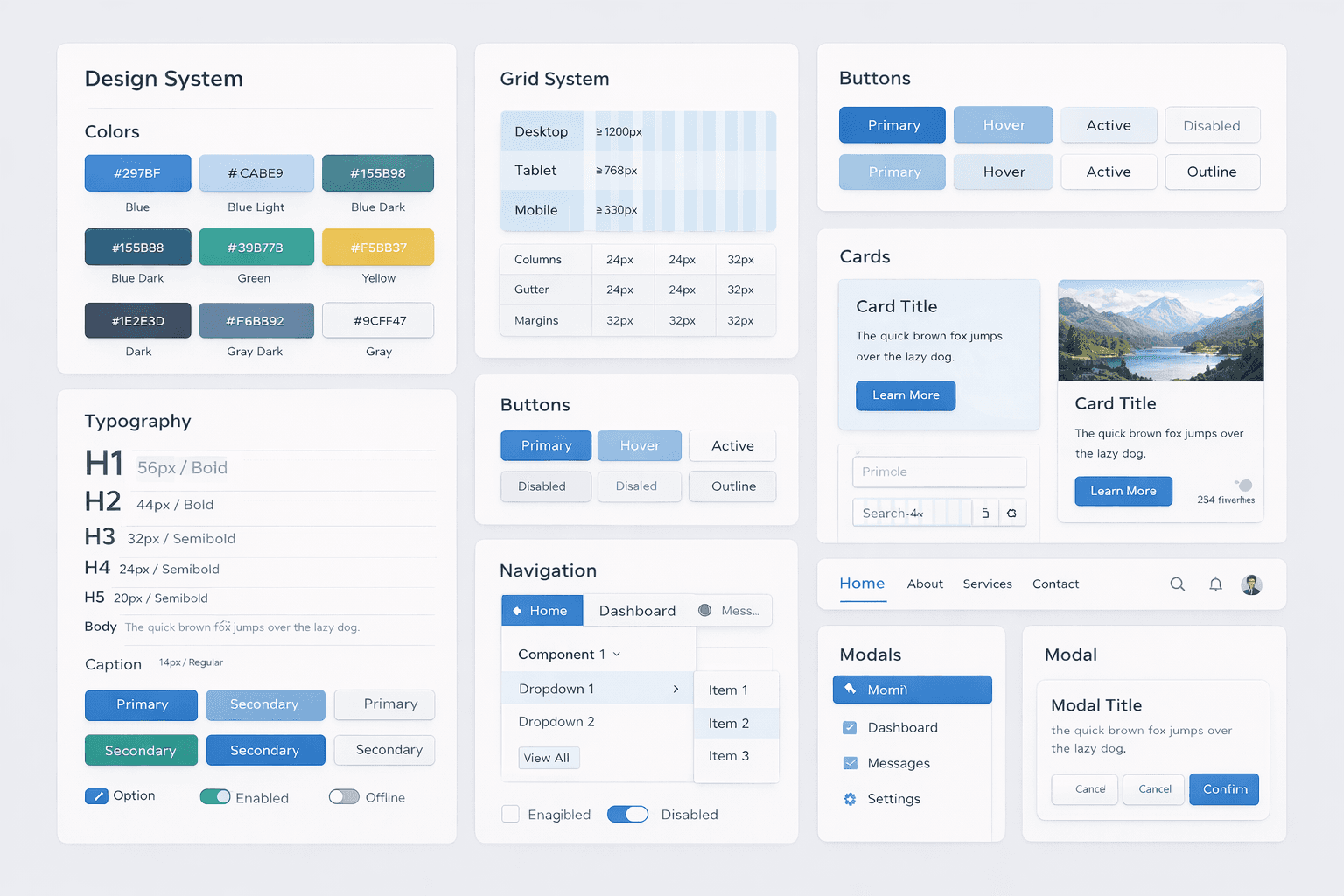
Use this framework: "You are a Design Systems Architect. Create a design system specification for [product type] with [design style] aesthetic. Include: 1) color palette with primary, secondary, and neutral colors plus usage guidelines, 2) typography scale with font families, sizes, weights, and line heights for each heading and body level, 3) spacing system with base unit and scale, 4) component specifications for buttons, forms, cards, and navigation with states and variants, 5) responsive breakpoints and grid system. Format as technical documentation a developer could implement."
The "developer could implement" constraint forces precision. You'll get hex codes, pixel values, and specific component states instead of vague design principles.
When you need visual representations of design systems for presentations or style guide documentation, the Modern Web Design System Generator creates comprehensive component library mockups with color palettes, typography scales, and responsive grid frameworks.
UX Research and User Flow Mapping
ChatGPT excels at structuring research frameworks and mapping user journeys. The key is providing enough context about your users and their goals.
Try this approach: "You are a Senior UX Researcher. Design a user research study for [product] targeting [user segment]. Research objective is [objective]. Include: 1) research methodology recommendation with rationale, 2) participant recruitment criteria and screening questions, 3) interview guide or survey questions, 4) analysis framework for synthesizing findings, 5) deliverable format for presenting insights to stakeholders. Timeline is [timeframe] with [budget level] resources."
The timeline and budget constraints are critical. They force ChatGPT to recommend realistic methodologies instead of ideal-world approaches that require six months and a research team.
For teams analyzing existing research data, the UX Research Insights Analysis prompt transforms raw user research into prioritized design recommendations with implementation roadmaps.
Mobile App UX and Interaction Design
Mobile app prompts need platform-specific considerations. iOS and Android have different design patterns, and your prompt should acknowledge that.
Structure it like this: "You are a Senior Mobile UX Designer specializing in [platform]. Design the user experience for a [app category] app with primary function of [function]. Target users are [user type]. Include: 1) app structure with main screens and navigation pattern, 2) key user flows with screen-by-screen breakdowns, 3) interaction patterns following [iOS/Android] guidelines, 4) onboarding flow with user education strategy, 5) edge cases and error states. Prioritize [user goal] while maintaining platform conventions."
The platform conventions instruction keeps recommendations grounded in real-world design patterns instead of theoretical ideals that violate user expectations.
The Mobile App UX Design prompt provides detailed user flow architecture with platform-specific interaction patterns for both iOS and Android applications.
Comprehensive UX/UI System Architecture
For enterprise products requiring full design system documentation, you need a prompt that addresses governance, scalability, and team collaboration.
Use this structure: "You are a Design Systems Architect building systems for [product scale]. Create comprehensive design system documentation including: 1) design token framework with naming conventions, 2) component library architecture with atomic design principles, 3) accessibility standards and WCAG compliance approach, 4) design system governance model, 5) documentation structure for design and engineering teams, 6) versioning and update strategy. Team structure is [team size/structure]. Product complexity is [complexity level]."
The governance model is what separates hobby projects from professional systems. Without it, design systems decay into inconsistent component libraries that nobody maintains.
For teams building scalable design systems with detailed component specifications and design token frameworks, the UX UI Design System prompt creates enterprise-grade documentation with interaction patterns and collaboration frameworks.
User Research Study Design and Methodology
Research study design requires balancing rigor with practical constraints. Most teams don't have unlimited time or budget for research.
Try this framework: "You are a Senior UX Researcher designing a study for [research objective]. Available resources: [timeline] and [budget level]. Target participants are [user segment]. Include: 1) methodology selection with trade-offs explained, 2) sample size recommendation with statistical justification, 3) recruitment strategy and screening criteria, 4) research protocol with specific questions or tasks, 5) analysis approach and insight synthesis framework, 6) deliverable format optimized for [stakeholder type]. Prioritize actionable insights over academic rigor."
The "actionable insights over academic rigor" instruction keeps recommendations practical. You'll get research designs that actually ship instead of perfect studies that never happen.
The User Research Study Design prompt provides comprehensive methodology frameworks with participant recruitment strategies and analysis approaches for generating actionable UX insights.
Website Wireframe and Layout Strategy
Wireframe prompts work best when they focus on information hierarchy and content strategy rather than pixel-perfect layouts.
Structure it this way: "You are a Senior UX/UI Designer creating wireframes for [website type]. Primary goal is [conversion goal or user objective]. Target audience is [user type] accessing primarily via [device type]. Include: 1) homepage wireframe with section descriptions and content priorities, 2) key interior page layouts, 3) responsive behavior for mobile/tablet/desktop, 4) conversion optimization elements with placement rationale, 5) content strategy for each section with word count recommendations. Focus on information architecture and user flow over visual design."
The content strategy with word counts is what makes this immediately useful. Designers know exactly how much content each section needs to accommodate.
For generating professional wireframes with clear information architecture and responsive design principles, the Website Design Wireframe Generator creates comprehensive layout strategies with user flow considerations.
What Actually Makes These Prompts Work
The pattern across all these templates is specificity in context and constraints. You're not asking ChatGPT to "be creative" or "think outside the box." You're giving it a clear problem space, specific deliverables, and success criteria.
The best prompt for website and branding ChatGPT applications shares these elements: role definition with expertise level, strategic context including audience and goals, explicit deliverable format, and constraints that prevent generic output. When you include all four, you get recommendations you can actually implement.
Start with one of these frameworks, customize the variables for your specific project, and iterate based on the output quality. The first generation might need refinement, but the structure gives you something concrete to improve rather than starting from scratch each time.
For more specialized prompts across different use cases, browse the full collection of business strategy prompts or explore text generation prompts for content creation workflows.
Keep reading: our guide to building a prompt library for storing variants, the full business strategy prompt library, or curated marketing prompt bundles.
ChatGPT branding prompts FAQ
Which AI is best for branding work?
ChatGPT-4-class models lead for naming, taglines, and brand voice — they're stronger at language nuance than image-first models. For visual identity (logos, color, typography), pair ChatGPT for ideation with Midjourney or DALL·E for execution.
Can I use ChatGPT to name my company?
Yes, but treat it as a brainstorm partner, not a final authority. ChatGPT excels at generating 50 candidate names against your constraints; you (or a human reviewer) still need to filter for trademark availability, domain availability, and pronounceability. Don't ship a name without those three checks.
Will ChatGPT-generated branding be unique?
Only if your prompt is. Generic prompts produce statistically average names — nothing is unique about "FlowSync" or "BrandHub". Force differentiation by feeding the prompt a real customer pain point, an unusual constraint (e.g., "must be a verb"), or a strong reference brand to riff off.
How do I use these prompts in ChatGPT?
Copy the template, replace the [VARIABLES] with your specifics, and paste into a fresh ChatGPT session. For longer multi-step branding work, save the working prompt to a prompt library so you can iterate across versions.
Prompts in This Article
Try these prompts mentioned above — click to view full details.
Brand Identity Strategy Framework with Voice Development
Creates comprehensive brand identity strategies including positioning, voice guidelines, and messaging frameworks for consistent brand communication across all touchpoints.
Brand Voice Guidelines Generator with Tone Framework
Develops detailed brand voice and tone guidelines with practical examples, do's and don'ts, and implementation strategies for consistent brand communication.
Expert Web Design Strategy and Technical Architecture
Provides comprehensive web design strategy including technical architecture, performance optimization, user experience design, and implementation roadmaps for professional web projects.
Trending Prompts
Comprehensive GTM Strategy Builder
Transform your product launch into a strategic success with this comprehensive go-to-market framework. This prompt generates detailed, actionable GTM strategies covering market analysis, positioning, pricing, distribution, and launch execution plans tailored to your specific product and market conditions.
LinkedIn Engagement Post Generator
Creates compelling LinkedIn posts optimized for audience engagement, profile growth, and professional networking. This prompt generates posts that encourage meaningful interactions through questions, insights, and valuable content while maintaining a professional yet personable tone.
Fashion Editorial Photography Prompt
Creates hyperrealistic editorial fashion photographs with authentic skin texture, premium fabric details, and cinematic lighting. Perfect for high-end fashion shoots and editorial styling.
Ready to level up your prompts?
Explore 226+ Marketing prompts for ChatGPT, Claude, Midjourney, and more on PromptCreek.