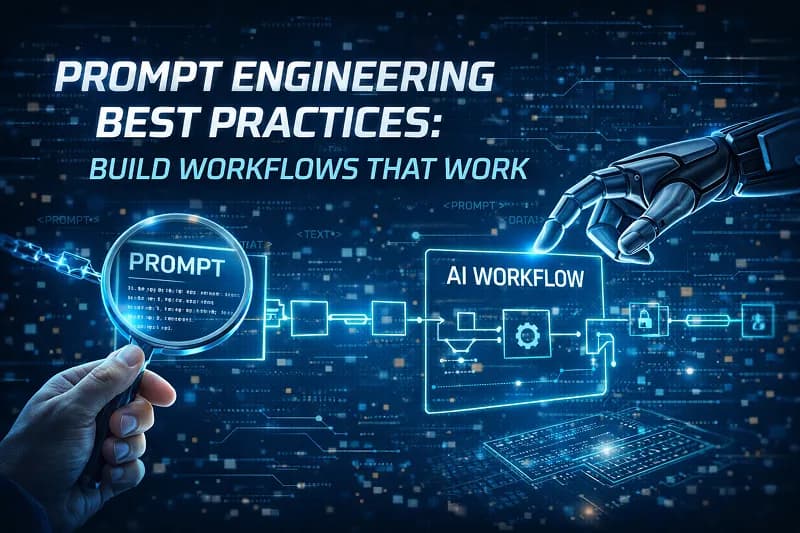
Prompt Engineering Best Practices: Building Workflows That Actually Work
You've probably been there: spending hours crafting what you think is the perfect prompt, only to get wildly inconsistent results. Here's the thing though — you're approaching it all wrong. Prompt engineering best practices aren't about finding that one magical phrase that solves everything. They're about building workflows that work reliably, every single time.
This guide cuts through the hype and shows you how to create repeatable systems that actually fit into your workflow. No more guessing games, no more starting from scratch each time.
The Prompt Engineering Paradox: Why 'Perfect' is the Enemy of 'Good'
Let's kill a myth right off the bat: there's no such thing as a perfect prompt. Seriously.
The people who claim they've found the ultimate prompt formula are either lying or haven't tested it across different scenarios. Real prompt engineering is messy. It's iterative. It's about building something that works 80% of the time, then refining it to work 90% of the time, then 95%. You're never going to hit 100%, and that's perfectly fine.
Think of it like tuning a guitar, you don't just twist the pegs once and expect perfect pitch forever. You adjust, test, adjust again. The goal isn't perfection; it's consistency.
This is where PromptCreek becomes invaluable. Instead of losing track of your iterations, you can save different versions of your prompts, tag them with performance notes, and actually see what changes moved the needle. When you find a prompt that works well, bookmark it. When you improve it, save the new version alongside the old one.
The real magic happens when you stop treating each prompt as a standalone creation and start building a library of tested, reliable tools. Learn how to build a prompt library that actually serves your workflow instead of just collecting digital dust.
Start thinking of prompt engineering as continuous process improvement, not a creative writing exercise. Your future self will thank you.
Beyond Keywords: Structuring Prompts for Predictable Results
Most people write prompts like they're talking to a really smart friend. But AI models aren't friends — they're pattern-matching machines that thrive on structure.
A well-structured prompt has four core components: context (what's the situation), task (what do you want done), constraints (what are the limits), and examples (what does good look like). Miss any of these, and you're gambling with your results.
Here's where delimiters become your best friend. Use XML tags, triple backticks, or clear section headers to separate different parts of your prompt. Instead of writing a wall of text, break it into digestible chunks:
```
Context: You're a technical writer for a SaaS company
Task: Simplify this API documentation for new developers
Constraints: Keep it under 500 words, use examples
Examples: [paste 1-2 good examples here]
```
This structure works across different AI tasks. For image generation, your context might be the style and setting, your task the specific subject, constraints the technical parameters, and examples reference images or detailed descriptions.
For code generation, context sets the programming language and project scope, task defines the specific function needed, constraints cover performance requirements, and examples show the coding style you prefer.
The key is consistency. Once you find a structure that works for your use case, stick with it. Your prompts become predictable, which means your results become predictable.
Defining roles and personas adds another layer of reliability. Instead of hoping the AI interprets your intent correctly, explicitly tell it what role to play. "You are a senior marketing strategist with 10 years of B2B experience" gives much clearer direction than "help me with marketing."
Browse text generation prompts to see these structures in action across different use cases.
Prompt Chaining: Building Complex AI Workflows Step-by-Step
Single prompts are like trying to build a house with just a hammer. Sure, you might manage something, but you're not going to like the results.
Prompt chaining breaks complex tasks into smaller, manageable pieces where each prompt handles one specific job. The output from prompt A becomes the input for prompt B, and so on. It's like an assembly line for AI tasks.
Say you're creating a marketing campaign. Instead of asking for everything at once (and getting a generic mess), you chain the process: first prompt analyzes the target audience, second develops key messaging based on that analysis, third creates specific content pieces using those messages, fourth optimizes for different channels.
Each step builds on the previous one, maintaining context while allowing you to course-correct if any individual step goes off track. You can test and refine each link in the chain independently.
The trick is designing handoffs between prompts. Be explicit about what information needs to carry forward. Use phrases like "Based on the audience analysis above" or "Using the key messages identified in the previous step" to maintain continuity.
Prompts in This Article
Try these prompts mentioned above — click to view full details.
Technical Documentation Simplifier
Transform complex technical documentation into clear, accessible guides tailored to different audience levels. This prompt helps break down jargon, create helpful analogies, and structure information progressively from basic concepts to advanced details.
Comprehensive GTM Strategy Builder
Transform your product launch into a strategic success with this comprehensive go-to-market framework. This prompt generates detailed, actionable GTM strategies covering market analysis, positioning, pricing, distribution, and launch execution plans tailored to your specific product and market conditions.
Trending Prompts
Comprehensive GTM Strategy Builder
Transform your product launch into a strategic success with this comprehensive go-to-market framework. This prompt generates detailed, actionable GTM strategies covering market analysis, positioning, pricing, distribution, and launch execution plans tailored to your specific product and market conditions.
LinkedIn Engagement Post Generator
Creates compelling LinkedIn posts optimized for audience engagement, profile growth, and professional networking. This prompt generates posts that encourage meaningful interactions through questions, insights, and valuable content while maintaining a professional yet personable tone.
Fashion Editorial Photography Prompt
Creates hyperrealistic editorial fashion photographs with authentic skin texture, premium fabric details, and cinematic lighting. Perfect for high-end fashion shoots and editorial styling.
Ready to level up your prompts?
Explore 162+ code-generation prompts for ChatGPT, Claude, Midjourney, and more on PromptCreek.